
Letters from the Future are co-created global feminist messages from the future we want. It’s a vision of a just future where everyone has full bodily autonomy.
Together with feminists across the globe, we are drawing a vision of the future we want, rooted in our collective imagination. We invite partners & activists to submit a Letter from the Future to contribute to an interactive online platform. Through these letters, we remind each other that a better future exists, and that we must continue holding the line together across feminist & queer movements.
In this future, justice is inseparable from bodily autonomy. Bodily autonomy is not a privilege, but a non-negotiable right, rooted in Indigenous knowledge, communities of care, and the freedom to exist and become, on our terms. Our bodies are no longer battlegrounds for ideology, control, or extraction. Safety feels ordinary rather than exceptional.


For me, the ideal future is one where all intersex people are free to exist without harm—where they have full bodily autonomy, self-determination, and are recognized as thought leaders. In a world where our bodies are under attack, it's crucial for feminists to embrace true intersectionality, ensuring no one is left behind and all harms are addressed. We hold the power to create the future we envision. By being intentional and making inclusivity central to our vision, we can shape a world that truly welcomes and protects everyone.
Crystal Hendricks, Programmes Officer - Sex Characteristics, ILGA World
“My body, my choice” is a rallying cry for feminists worldwide, but unfortunately, this simple statement is yet to be realised around the world.
A feminist future of justice is one where this statement becomes the reality for women in all their diversity the world over. Why is it that certain individuals are deemed more worthy of this right than others? Why is it that trans, gender diverse, and intersex bodies are not afford this same right? How can we speak of justice if we exclude those at the margins?
My hope for the future is one where we can say the phrase “my body, my choice,” with confidence. That rather than being a statement of aspiration, it will become an affirmation of truth.
By Lily Dong Li Rosengard (they/them), Senior Specialist: GIESC, ILGA World
In the future, we will have access to safe abortion all around the world, without the need to prove xyz just to have a medical right to our own body. Head coverings for Muslim and/or other Religious women will not be shunned or prohibited in the West, but will also not be enforced or used as a means of control in the East. Women will be presented with equal opportunities as men, without our nuances going unaccommodated. Further research into our physical health is endeavoured, and the differences it has in comparison to men’s; no more doctors brushing off our pain with paracetamol. Our ancestors gave us the right to vote in 1918, so we must continue to use our voice, not only to help ourselves, but especially to aid women whose voices still go unheard. And after this, we will have recognised that these issues do not solely affect women, but rather, all who society deems as women; which will be the final patriarchal fabrication we dismantle.
By Coral | she/they
How Impossible?
By Eleanor Hammer
When I lace up my running shoes, lace up my boxing gloves, lace up my short black dress
I don’t think how impossible this must have seemed
a hundred years ago.
How impossible to belong to myself before a husband,
to sign alone for a bank account, or a home,
to have a vote, a say.
How impossible
like trying to hold onto smoke as it curls round your fingers
how hopeless it must have felt sometimes
for the women fighting,
trying over and over again, for these things that I don’t think about.
There’s a woman a hundred years from now
who wouldn’t think twice about calling the police, who knows she’ll be heard,
that her underwear won’t be held up as evidence as if it could consent for her,
that won’t understand how anyone could have ever said she was asking for it,
who never imagined the shame could be hers.
She will think how it must have seemed impossible, a hundred years ago,
for the women trying over and over again,
how hopeless it must have felt sometimes
like screaming in a thunderstorm
How impossible
These things that she doesn’t think about
Together, Let’s Build a Powerful Feminist Digital Archive
International Women’s Day 2026
By Lohoma
Dear friends,
This International Women’s Day, let’s do something meaningful. Let’s create a space where women’s stories are saved, shared, and respected.
For too long, many women’s voices have been ignored or forgotten. The struggles, the sacrifices, the quiet strength, they deserve to be remembered. A feminist digital archive is not just about history. It is about truth. It is about making sure our stories cannot be erased.
Every woman’s experience matters. Whether she is leading a movement or leading her family through hard times, her story is important.
Let’s build a future where girls can look back and see the courage of the women before them.
Together, we can create something powerful.
Together, we can make sure women are never invisible again.
With hope,
Lohoma
Dear Sisters, Siblings, and Allies!!!
On this International Women’s Day, I write to you not just with a message of celebration, but with one of unwavering solidarity and defiant hope.
Today, we look around the world and see a landscape of breathtaking resilience and heartbreaking challenge. We see women leading protests for freedom in Iran, demanding the right to simply exist without a male guardian. We see mothers in Gaza sifting through rubble, embodying the fierce strength that ensures survival. We see women across every continent fighting for bodily autonomy against a rising tide of authoritarianism that seeks to control and confine us.
This is the world we inhabit. And it is precisely because of this world that International Women’s Day remains as vital as it was over a century ago. It is not just a day for flowers and pastel-colored marketing campaigns. It is our day to collectively bear witness.
We bear witness to the women who came before us, the suffragettes, the labor organizers, the unsung heroes of every civil rights movement. They were the first to understand that the personal is political, that the struggle for a fair wage is inseparable from the struggle for safety in our own homes, and that the right to vote is hollow without the right to live without fear.
We bear witness to the sheer, dazzling diversity of womanhood. The experiences of a Black woman in the American South are not the same as a trans woman in Argentina, which are not the same as a Dalit woman in India. A feminism worth its name is an intersectional feminism. It fights for the most marginalized among us, knowing that until all of us are free, none of us are free. We must actively listen, uplift, and cede the floor to those whose voices have been historically silenced. Our movement is not a monolith; it is a glorious, complicated, and powerful chorus.
We also bear witness to the struggles that persist in the shadows. The epidemic of violence against women, the gender pay gap that punishes our labor, the lack of access to healthcare and childcare, the climate crisis that disproportionately impacts women in the Global South. We see the quiet, daily heroism of the single mother working two jobs, the woman navigating a hostile workplace, the girl fighting for her education.
So, what do we do with this witnessing? We turn it into action.
To my fellow feminists: Let today be a day of reckoning and re-energizing. Celebrate the victories, yes, but let them fuel the fire for the battles ahead. Check in on each other. Mentor a young woman. Challenge the casual sexism you hear. Show up for the rights of trans women as if they were your own. Our liberation is bound together.
To our allies: We see you, and we need you. True allyship is not performative. It is using your privilege to amplify our voices, not speak over them. It is holding other men accountable. It is sharing the domestic load. It is being an active participant in the conversation, not just a bystander.
Today, I am thinking of the girl who is told she can’t be an engineer, the woman who is afraid to walk home alone, and the elder who has fought this fight for decades and is weary. To you, I say: We are with you. We are the ones you have been waiting for.
Our fight is not for a seat at a broken table. It is to build a new, sturdier, more inclusive table, where everyone has a place. It is a fight for a world where our daughters can inherit more than just our hopes, but a reality where those hopes are no longer necessary.
So, let us march. Let us organize. Let us shout. Let us whisper words of comfort to the weary. Let us build a future, together.
In love, rage, and relentless hope...
A Feminist
As Black diapora feminist, we come from a long line of women who had no choice but to hold onto their imagination and hope in order to create new possibilities. Generations before, scattered by wars and instability across the world, carried visions of different futures, despite when the conditions around them offered very little.
For us in the diaspora, we continue to navigate spaces that were not designed for us, shut out from table of discussion, spoken for and over.
Yet, as frontline actors working alongside local communities in responding to crisis, we will continue to hold onto the torch of hope passed down through generation. We will turn out margins into sites of radical perspective, re-imagination, resistance and solidarity, spacs where continue to cultivate and exchange ideas, co-design out global south feminist agenda, and strengthen our connection across context.
Our future depends on our ability to build and deepen our Global South Feminist Solidarity movement, intentionally, collectively and across borders.
IMatter women's right campaign consultant
Dear Feminista,
I hope this missive of mine finds you well.
Today, on IWD, I write to you from a future we once only imagined. A society where bodily autonomy is unquestioned. Here, every woman and girl grows-up knowing her body belongs to her and has the freedom to make decisions about her body and life without stigma.
I often think about Shekwoya, who suffered in silence after being denied sexual reproductive care by judgmental providers. In this future, her daughter visits a community PHC staffed with respectful providers who listen without judgment.
I think of Hadiza, who was forced to drop out of school at the age of 13 to face marriage and the strain of pregnancy. She became a mother before she could understand her childhood. In this future, none of that defines girlhood; marriage happens by choice, pregnancy is planned, and safe. Practices that once harmed girls are no longer justified in the name of culture and or religion.
Slowly, the change came, thanks to your brave activism against injustice, your pushbacks against oppressive systems, and collective community action. Today, girls have learned to own their own space and make their own choices.
With hope and solidarity
By NAYA Nigeria
Amada sobrina,
Te escribo desde la memoria y la esperanza, para que recuerdes siempre que el mundo que hoy te abraza fue defendido y transformado por mujeres que se atrevieron a imaginar un futuro distinto y trabajaron colectivamente para hacerlo posible.
Si hoy puedes caminar con libertad, decidir sobre tu cuerpo sin miedo y nombrarte como quieras nombrarte, es porque antes hubo muchas mujeres que nos precedieron, tus ancestras fueron abuelas, jóvenes, trabajadoras, artistas, campesinas, estudiantes que desde su rebeldía resistieron y cuestionaron las normas impuestas.
Mujeres que marcharon, que escribieron y reescribieron la historia, ellas denunciaron, cuidaron, y sobre todo se organizaron en comunidad para que tu mundo fuera distinto al que ellas heredaron.
Hubo un tiempo en que aun existiendo leyes no eran una garantía para tu autonomía, aun se disputaba el derecho a decidir ser madre o no, incluso amar a quien se quisiera amar, era motivo de juicio, violencia o silenciamiento. Desde la incomodidad se crearon futuros imaginados para que tu generación no tenga que pedir permiso para existir ni que espacios ocupar.
Transformaron la manera de entender el amor dejando de romantizar el sacrificio o dolor, reconociendo que el amor habita en la amistad, en el estudio, trabajo, en el cuidado colectivo, en la risa compartida, en la comunidad que la sostiene y en la lucha combativa, reescribiendo la narrativa que reducía a las mujeres a cuerpos sexualizados recordando que somos pensamiento, creatividad, fuerza política, ternura, inteligencia, contradicción, deseo y autonomía, aceptando que nuestro valor no depende por un sistema creado por hombres para hombres, las desobedecieron, las desobedecimos.
¡El mundo comprendió que No es No! Una frase corta pero llena de poder, amor y consentimiento.
Lo que parecía una lucha individual se volvió fuerza colectiva entendiendo que frente a las múltiples opresiones se podía construir un futuro mejor para las nuevas generaciones.
Si hoy respiras un aire más justo, es porque hubo resistencia
Si hoy puedes elegir, es porque muchas antes que tú se negaron a obedecer
Si hoy puedes soñar en grande, es porque muchas se negaron a aceptar un destino pequeño
¡¡¡El feminismo no fue solo una lucha, fue una forma de amar la vida con libertad!!!
Con esperanza, fuerza y ternura,
By Bolivia



Dearest Feminist Reader,
It has come to this Pan-African Feminist's attention that while the grand conference and negotiation halls of power glitter with declarations of progress, the true battle for our feminist collective future is being waged in far less visible chambers.
There is much talk of justice. There is an endless ceremony in its name. And yet, what is justice without bodily autonomy? What is access without the fundamental right to one’s own body? Until we dare to root our shared vision of the future in bodily autonomy, we build colonial and patriarchal palaces upon our bodies.
From the perspective of those who labor within our Political Leadership Incubator (PLI), and from the years of work crafting the Nalafem Academy, a most inconvenient truth emerges: to change the system, one must not only protest at its gates, but enter its corridors, sit on its tables, befriend its members and shift power through shifting thinking, data and values. It means refusing fragmentation. It means recognizing that justice negotiated in New York shapes lives in Addis Ababa, Brussels, Panama City, and beyond. It means understanding that solidarity is not sentimental. It is structural!
For years feminist organizations and activists, and especially young feminist movements, have organized from the outside. Each year we are swept into the whirlwind of side events and parallel convenings, rarely invited into the closed negotiations where Member States hold the pen and draw the lines that shape our realities. In Africa particularly, feminists have been holding the line without always being allowed near it.
Meanwhile, anti-rights actors grow bolder. Resources grow scarcer. Narratives once thought settled are now reopened with alarming ease.
All the while between whispers that Africa must retreat to the national. But let us be clear! What is “national” is dictated by the regional, and what is regional is shaped by the global. If Africa does not lead in those spaces, Africa will be led. And so it is not withdrawal we require, but leadership. Political Leadership! African feminist politicians, young and old together in intergenerational co-leadership. Setting regional and global agendas, not merely responding to them.
In Europe and North America, future leaders are being cultivated with impressive polish, yet often with little reckoning with the histories that position them where they stand. Colonization is not an anecdote of the past; it is a living architecture of power. To ignore it is to reproduce it.
We require politicians in the Global Minority who understand this history, not abstractly, but materially. Politicians who practice decoloniality as value and method not rhetoric. Politicians who work alongside African counterparts, carry the same commitments. The role of PLIs, then, is most strategic. To shape both future and current politicians who are willing to shift power.
In the year 2026, the Africa Group still seeks to remove the word “all” from “all women and girls” in negotiated texts. A single word, some may say. But language is power. “All” is bodily autonomy. “All” is access to justice. “All” is the line between universality and exclusion. To strike it out is not administrative. It is patriarchal. It is colonial. It is anti-justice.
If we are to build a future worthy of its name, we must dare to root it in bodily autonomy, to work both outside and inside the system, and to ensure that “all” truly means all.
Yours in action,
Dr. Syeda Re’em Hussain
Nalafem (Nala Feminist Collective)
Body As Archive
Tafahri Munjatta, Nairobi, Kenya
I send this from the fractals of the future, where bodies remember themselves as libraries. Every scar, every curve, every heartbeat archives a rebellion. Our movements are protests; our breath, a manifesto.
We have learned that autonomy cannot be legislated, that it must be inhabited, practiced daily, like sunlight threading through leaves or song rising from the earth. Machines pulse in rhythm with us; they do not dictate. Our pleasure is strategy, our grief a map to liberation.
You, reading this, are both ancestor and witness. The choices you make in the quiet of your body, the resistances that feel invisible, are already building the world we now inhabit. There is no divide between sacred and political; each gesture of care, each refusal, each embrace of joy, writes the future into being.
Remember: autonomy is contagious. Tend it in your flesh, speak it to the air, plant it in your neighborhoods. Your body is both shield and seed, and we are flowering in the soil your courage has prepared.
From the future, where we dance,
where we remember,
where we rise.
We may come from different places, hold diverse beliefs, come from vastly diverging economic backgrounds or like our food in unique ways, and it is our human ability for compassion that allows us to relate to each other and lets us agree that everyone should be able to make decisions about their own bodies, lives, and futures, never mind our differences.
Today, reactionary politicians and groups are transforming this reality into something warped. Many keep obsessing about the bodies of women — as well as those of trans, gender diverse, and intersex people — dictating what we may do with our bodies and how much space we should occupy in society.
For me, the ideal future looks like a space in which we have full agency over our lives and can decide about our bodies. Where respect, understanding and compassion replace judgement and scrutiny. Where everyone can show up for their communities and feel safe to be who they are.
Julia Ehrt, Executive Director, ILGA World
How do we dismantle the structural barriers that limit bodily autonomy and reproductive justice? It cannot be done alone. To create our imagined future, we must collectively act together, now. This means rejecting the heteropatriarchal norms that define whose bodies matter, who we get to love, and who gets to reproduce and produce life.
Together, we must challenge the capitalist systems that force us to commodify our bodies and regulate our time in return for subpar healthcare, childcare, housing and mobility. How can we thrive where economic survival is precarious? It cannot be done alone. We need to organise for conditions that support accessible healthcare and community-based care networks, and tear down systemic inequalities.
As a collective, we must build sustainable community structures that co-create bodily autonomy. This cannot be realised as the individual, but through collective support, mutual aid, and solidarity across the divide. By reimagining our relationship with each other, outside of the rigid gender roles and compulsory norms, outside of the public/private divide, outside of the capitalist structures that commodify our labour, we can live the future that we imagine. Collective present-tense action will create our imagined future.
Amelie Eckersley, she/her, Germany



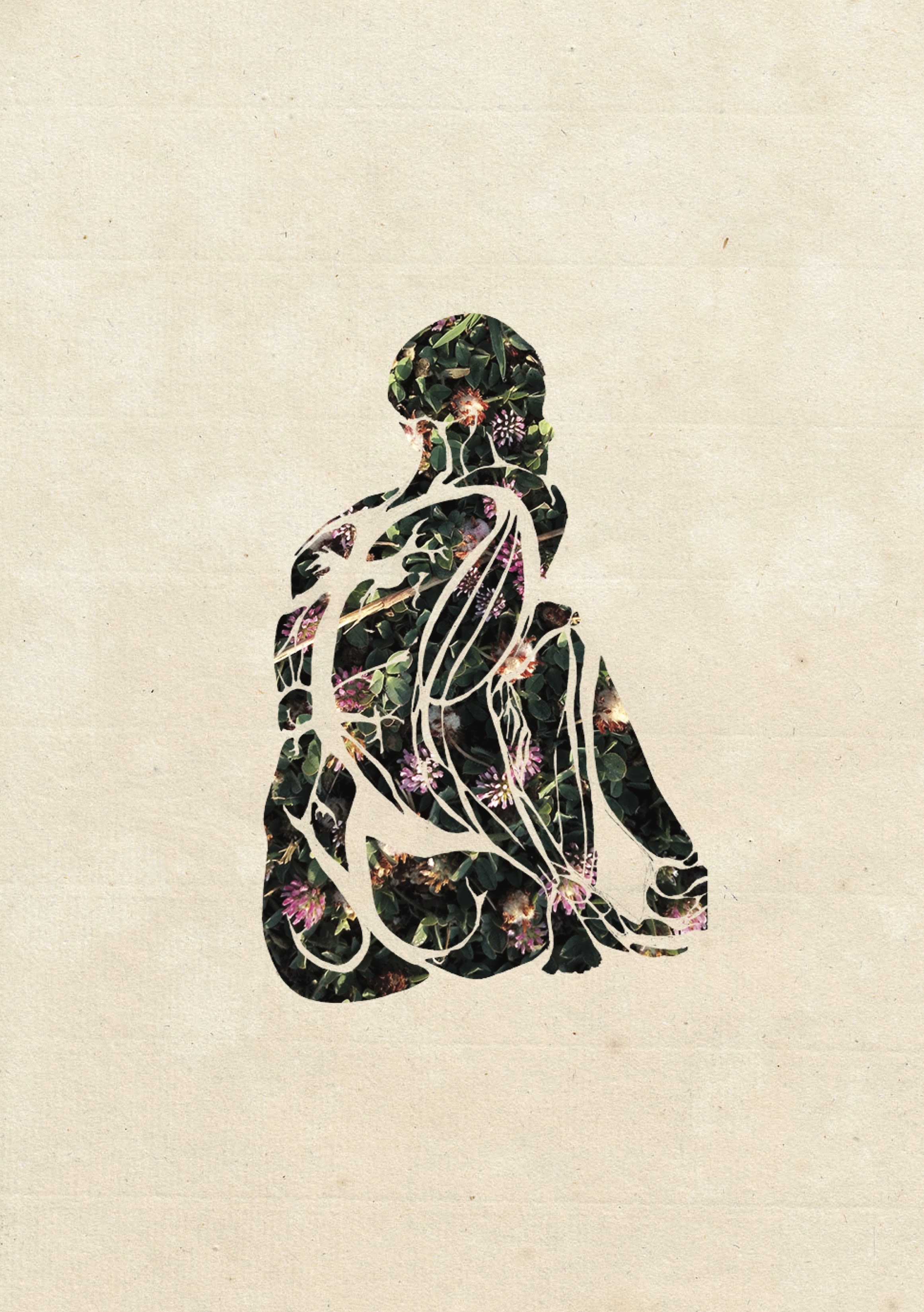

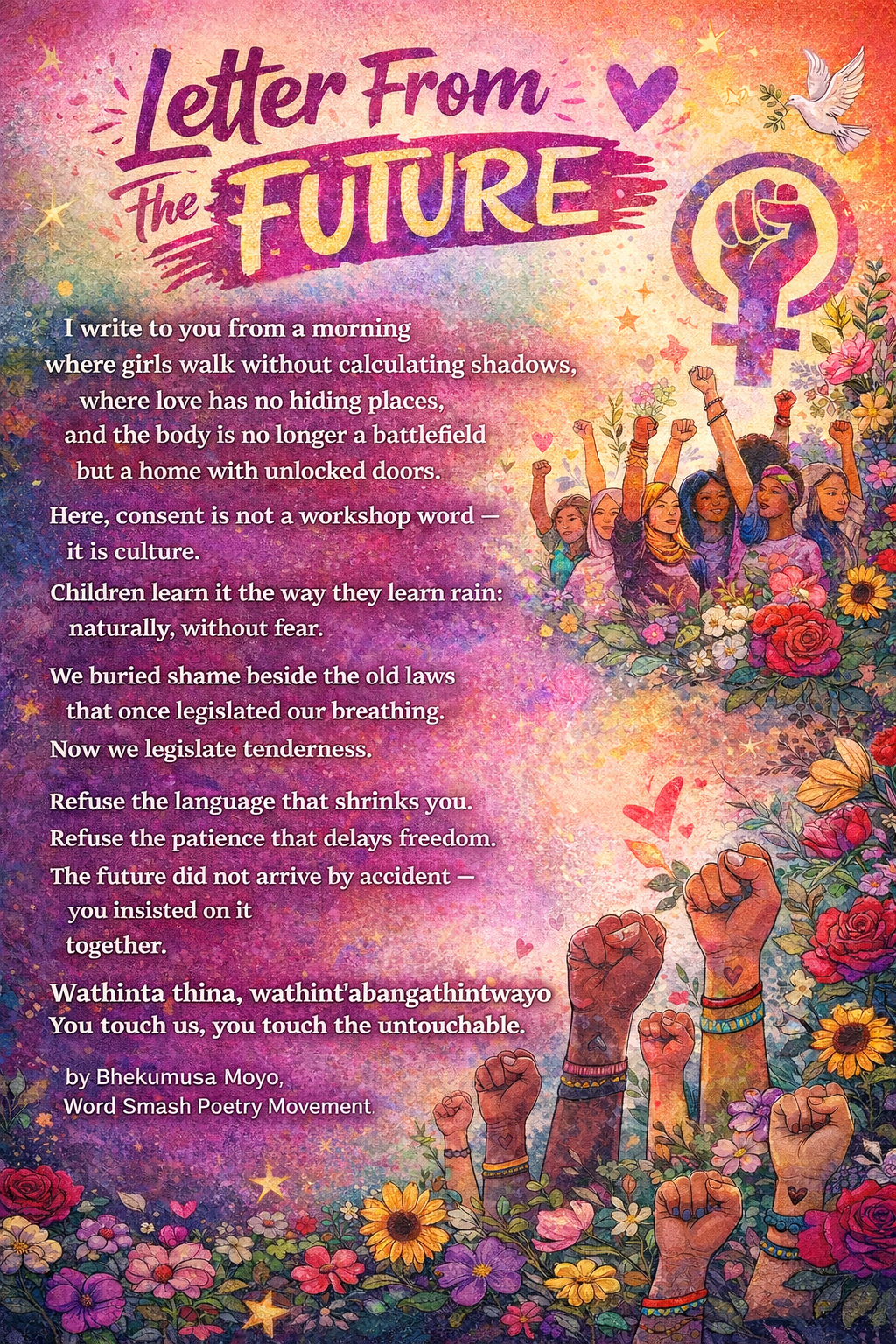




arrive in part,
arrive in full,
this is your home.
this body is home.
leave
when not accepted
that is no home
break down doors
that stop you--
home never turns you away
arrive in part,
arrive in full,
you are always welcome
at home:
in your body.
Youth for Innovation Trust/Word Smash Poetry Movement
We stopped the world to make ourselves heard.
We defended the right to decide
when they wanted to decide for us.
We shouted in the squares
that sex education is a right,
that legal abortion is social justice,
that girls are not mothers—
they are girls.
They said we had gone too far.
That it wasn’t the right time.
That there was no budget.
We responded organized.
It was a tide.
It was struggle.
It was moving forward—and never going back.
FEIM
Querida yo, ¿qué tal te va?
Sé que no todo está tan bien
Pero quería mostrarte
Lo lejos que llegaste
Seguro que hoy no lo parece
Pero mejora con los meses
Te contaría
Pero no me creerías
Querida yo, confío en nosotras
Lo estás haciendo bien1
Querida/e,
Faltan pocos minutos para las 4 de la madrugada del 14 de junio de 2018. Llevo más de 20 horas despierta y una decena de semanas de mal sueño. No es una madrugada cualquiera. Es una madrugada en la que finalmente parece que abrazaremos a la utopía, esa que nos hizo caminar durante más de 30 años para decidir libremente sobre nuestros cuerpos. Es una madrugada cargada de emoción, tensión y ansiedad, pero, sobre todo, de sororidad. Somos un millón en las calles, en toda la Argentina, y miles alrededor del mundo, por un sí a la justicia reproductiva.
La marea verde es una marea incesante por la justicia social, de género y reproductiva. Aquellos años, en Argentina y en América Latina, hicieron temblar las estructuras machistas y patriarcales de siglos. ¿Quiénes? Nosotras y nosotres: los movimientos feministas, LGBTIQ+ y de derechos humanos. Lo hicimos de manera articulada, intergeneracional, interseccional, transversal. Pero también lo hicimos desde la rebeldía con ternura, alegría y risas, desde los abrazos y el cuidado. Con glitter, con música, con artistas, con amorosidad, con creatividad. Con una ética de solidaridad. Lo hicimos juntes.
La marea no se detuvo, pero las reglas de juego se volvieron cada vez más crueles, impactando de lleno en la vida y en los cuerpos de las personas defensoras de derechos humanos y, en general, del mundo. Múltiples crisis, genocidios, odio, que siempre han existido, salieron a cara descubierta de sus trincheras y arrasaron con la salud del planeta y las vidas de las personas.
Sin embargo, cuando vos leas esta carta, en un futuro no muy lejano, sabrás que, a pesar de que nunca bajamos los brazos por la libertad de nuestros cuerpos y por vidas dignas de ser vividas, nos tocó barajar y dar de nuevo. Reorganizarnos, repensarnos, volver a articularnos. Y todo esto en medio de tanto dolor, crueldad, tristeza, pobreza de tiempo y de dinero. Nos tocó volver a encontrarnos en la ternura rebelde y en el hacer, alegremente, cosas terriblemente serias: sostener nuestros derechos e ir por más. Juntes, con solidaridad.
Ahora lo estás viendo; lo estás habitando. Somos nuevamente un rostro lleno de alegría, cansadas, sí, porque trabajamos duro, pero con los derechos sembrados en una tierra firme, seguimos haciendo historia. Caminamos con autonomía en nuestros cuerpos y con justicia en las manos. Estamos plenas, gracias a que nunca dejamos de creer, de tejer, de persistir. Y florecimos.
Pame Martín García
22 de febrero de 2026


The Reclamation of Women’s Sexual Pleasure
Anonymous
There was a time, when women were sovereign; they who are the feminine version of God, God’s intuitive nature, they of great discerning spirits, they who were translucent, able to easily tap in and out of spiritual realms. Women were divine, they were necessarily required in all aspects of life, they were crucial in the construction of a society; their wisdom deemed invaluable, their cycles respected and incorporated into the social order. Disturbance occurred, displacing the place of women in society, in community and in the family.
She was reduced to an item, a subordinate, a lesser being. How unfortunate, this system came to be known as “Partriachy”. Women’s power became a threat and needed to be tamed, muted and lulled. The woman’s voice no longer featured in key decision-making structures; she was to be the neck, not the head. Her sexual desire was to be controlled and strictly managed; her sexual explorations were to be condemned harshly and so names such as bitch, slut, whore were popularized to discourage her exploits. Her male counterpart would be pedestaled for the same behavior; he would be revered and called “isoka”, “inkunzi”, a casanova. Women began to reclaim their autonomy, to inform their own story about their bodies and their pleasure. The decentred men and that changed the game.
Letter from the future
Hadeel Qazzaz, MENA Gender Justice Coordinator, Oxfam International
I woke up this morning feeling happy and motivated for a walk near the beach. My partner is taking care of my two children today as part of their scheduled care leave from work. I have time to enjoy the peaceful morning, prepare for my intervention in parliament which has equal members of men and women and people from diverse genders, ethnicities and race. I am going to meet friends in the nearby national park which is buzzing with natural habitat.
Since the drums of war stopped twenty years ago, we could enjoy the benefits of peace and security. I cannot believe how much governments used to spend on military, weapons, police and security forces. Today we enjoy peace and security without any such spending. I hardly see a police officer anymore. In fact, last week in the parliament we received a report about how public spending on social security and equal access to services reduced crime to the minimum. Instead of prisons we have community services and people are much happier and more content.
We finally transferred all our energy to clean, renewable energy which helped creating the environment I am enjoying…the sounds of birds and the clean air. We managed to plant trees, enjoy fair water distribution and improved public transportation that uses clean energy. This stopped the climate crisis that our ancestors suffered from.
My kids will grow up in a clean and sustainable environment without fear of being discriminated against because of their color or religion. My daughter will be able to wear what she likes and be in any profession she excels at. My son is able to enjoy art and music as much as my daughter enjoys science and technology.
Today I walked into a community clinic that provides free sexual and reproductive health services free of charge to all women. I was grateful for the wonderful work of our grandmothers who fought for this. I could chose when to have children and the number of children I want. No social pressure and no medical concern. No one can deny me contraception or force me to use my body in any way I do not want.
With the 4-days work week, proper wages and some quality life-work balance people are happier, mental health is more stable and there is time to enjoy cultural events. With the equal distribution of wealth within our country and across countries, we are able to travel and explore the world, appreciate other cultures and learn from each other. Knowledge, science and free internet is enjoyed by all…
We live and practice our lives, not just talk about them.


Dearest sisters of tomorrow,
May you be spared of my sorrow.
And of our collective horror.
May you bleed life with pride,
May you never have to hide
The fluid from your insides.
May you only know the pleasure,
Of touch, and all its treasure.
And never not consensual.
May you walk home late at night,
Gazing at the moon, so bright.
Without clutching your keys in freight.
May you freely choose to abort,
Legally and in comfort
Without stigma of any sort.
May your body be your own
One that you can make moan
Loved in all shapes and tones.

I am writing from a future we have tirelessly worked to make real. A future where bodily autonomy is not something we are still fighting for.
Here, our bodies are no longer policed, regulated by fear or shame. Today, our bodies enjoy safety and mobility and access to care is not a privilege.
In this future, feminist and queer movements have shaped policy and knowledge and are not working as a reaction to crises after crises.
What made this possible? Collective care and infrastructure. Global and regional alliances coming together to build resilience and resistance. In this future, there is no room for hate, injustice or fear; there is no separation between economic justice and bodily autonomy.
To the feminists of today: make sure to protect this space, fund it and challenge its opponents, as this is what you will always come back to in times of need.
This future exists because we have treated autonomy as a mission that is worth organizing for every day.
Asfari Institute for Civil Society and Citizenship
There once was a Shadow with no name and knew nothing of itself. It lurked in tunnels with dim light because it was the only time its outline would be defined. A confirmation of its existence. With no acquaintance, its solitude became its only language.
One day,
as if sensing a shift, it drew deeper into the darkness. In the distance, a door creaked, allowing the brightness of the desert planes to push through unapologetically.
As the desert sands rose and settled, an ethereal voice, smooth as the texture of palm oil, broke the silence. “It is time,” it said gently.
The Shadow, as if entranced by the timbre of the echoing voice, leaned in.
Slowly creeping forward from hiding.
Realising the inevitability of its fragile nature, it responded, “If I come, I no longer exist.”
Silence stretched as movements drew nearer.
In a contemplative tone, the voice responded, “You know not who you are. Let it be revealed.”
With fearful attempt, the Shadow withdrew from the darkness of the tunnel. As it approached the door, the dust of the air rose as a cyclic tornado.
Until it came to be, that while the casting of dim light defined its figure, the Shadow existed in the breadth of the wind.
As the desert sand enveloped its vacuum, beneath, the earth opened, spilling its waters to fill the crevices of its being.
It grew hips. Each facet of its being is a picturesque embodiment of beauty and grace.
At its feet, life finally took form;
a meadow covered the surrounding landscape in vibrant hues.
Finally, in full awe of her essence, she recognised herself as a survivor of all that tried to consume her.
She became the custodian of her wildest dreams
and the unrealised glory she was yet to uncover.
Andréas Ruth Deolinda is a Congolese writer from the Republic of Congo, Brazzaville. As a narrative architect, she writes poetic and literary articles in both French and English. She is the founder of The Harvest Africa, a dual-strand organization. One part operates as a media publication dedicated to shifting focus from political ruptures to the layered social and cultural forces behind them. Through its foundation, the organization integrates stories from its youth projects to give voice to a population deserving of a platform for expression. The organization works as an integrated system to empower Africa’s people.

PERSONAL
TO
POWERFUL
Freedom without fear, solidarity without exception.

Join the fight for gender justice.
Subscribe to Oxfam’s Gender Campaign updates, as we stand in solidarity with the feminist and queer movements across the globe!
 Built with Shorthand